







Editor's Note: This article tells the story of a design journey spanning more than a decade—from a wall repeatedly struck by rolling stretchers to The Creation of Adam, a work that brings together medicine, architecture, and art. It is the story of how a steel artwork came to life inside a medical teaching facility.
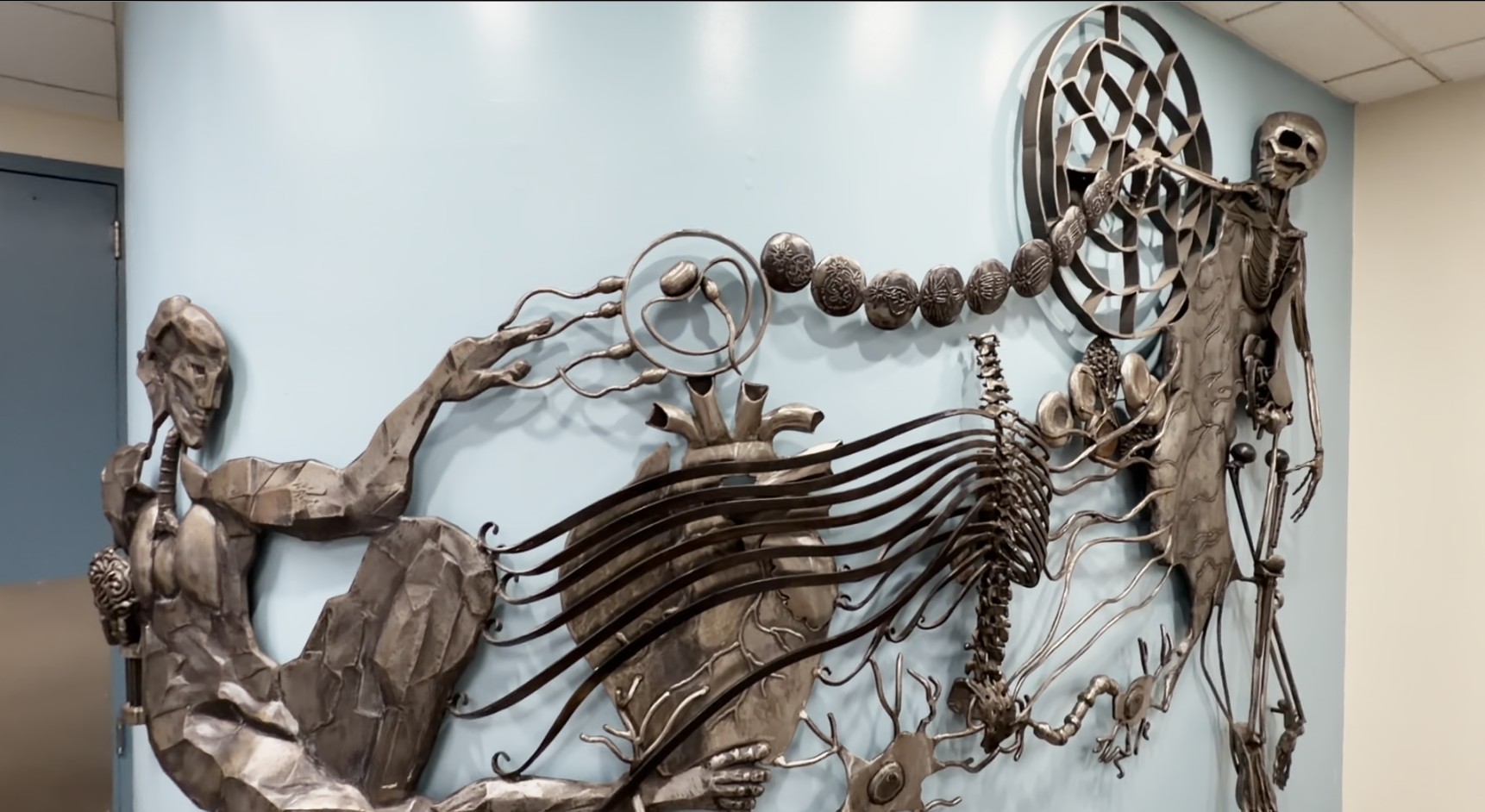
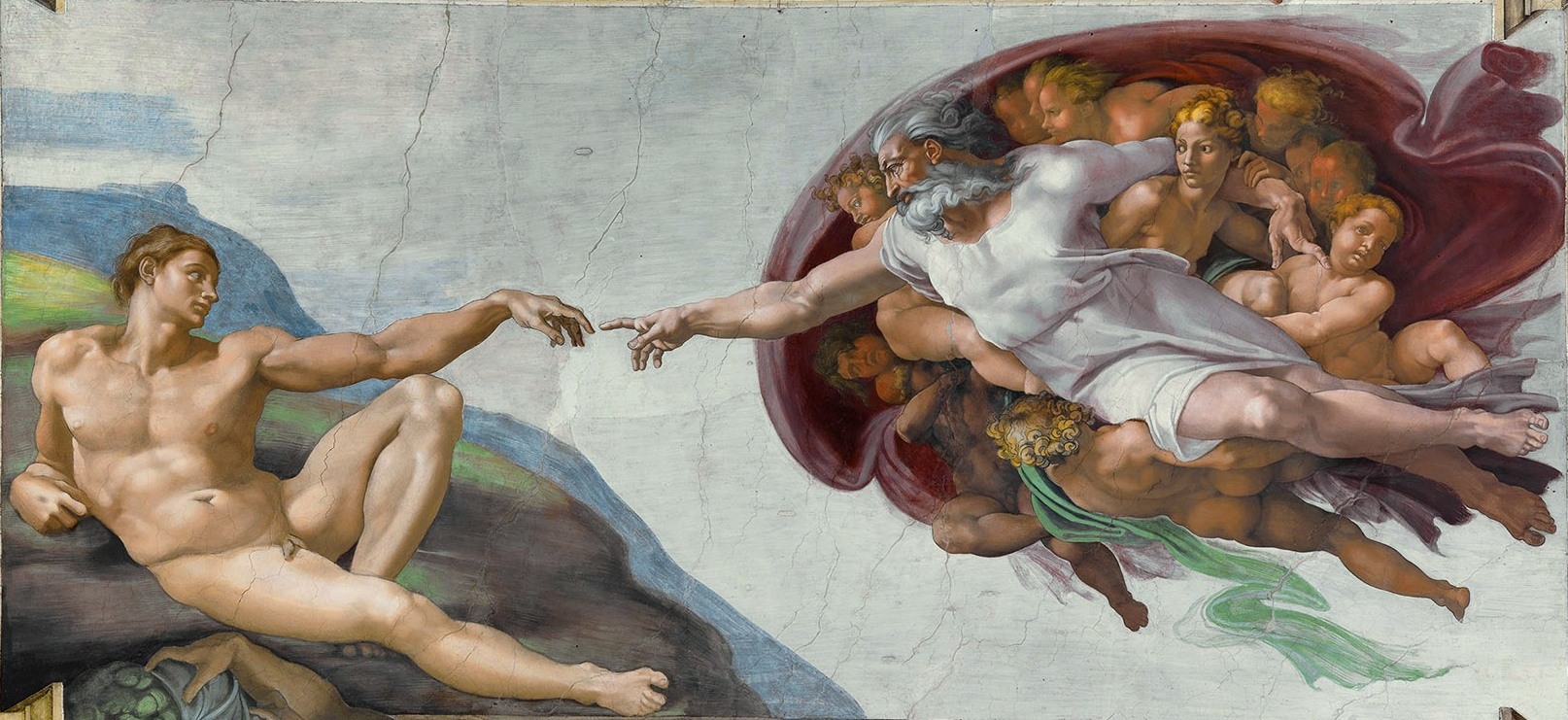
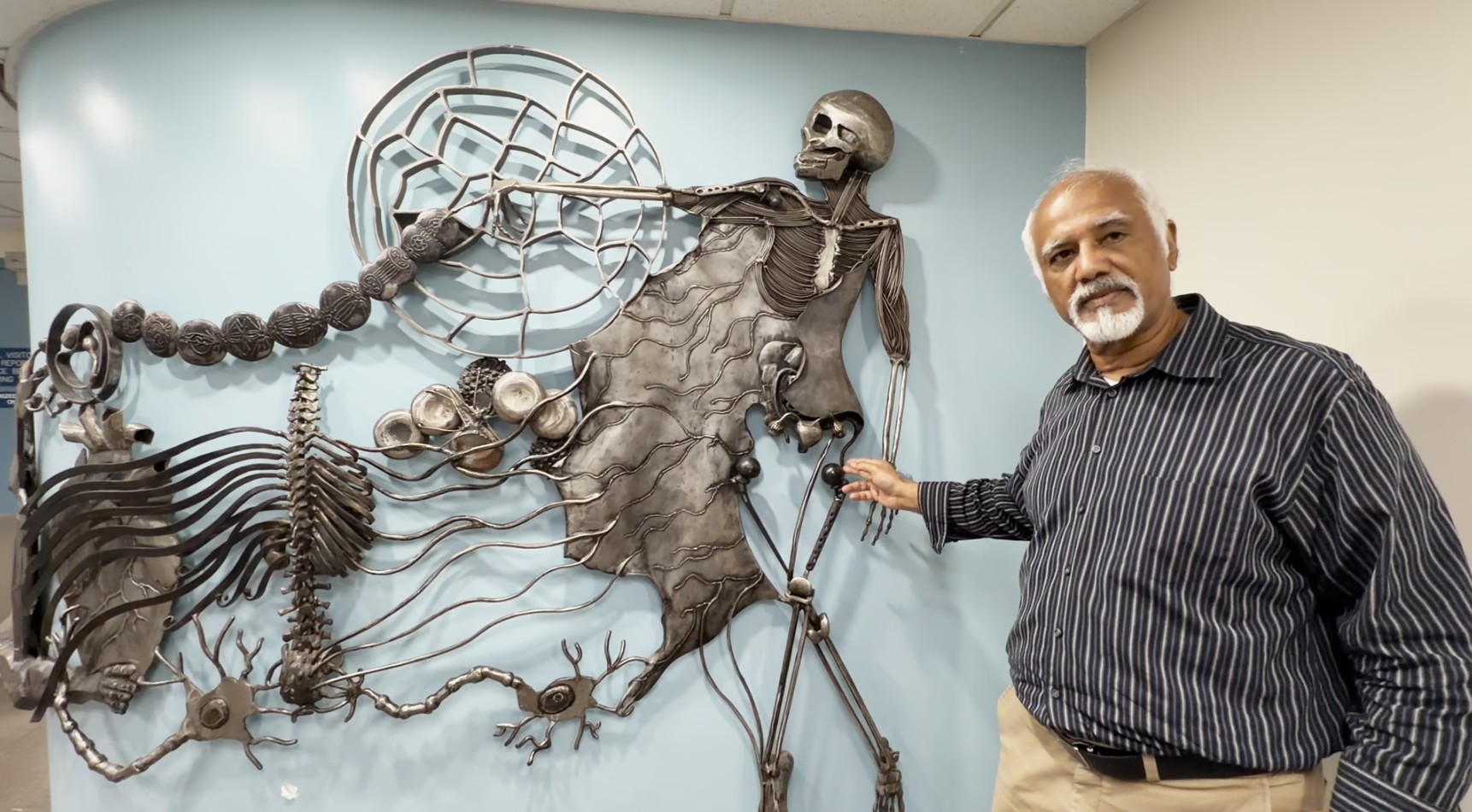
Exclusive interview by Celebrity Media reporter George: In the human anatomy teaching area of SUNY Downstate Health Sciences University in Brooklyn, New York, a large metal sculpture has quietly occupied an underground space for years, largely unknown to the public. Spanning the wall, the work uses the human skeleton and anatomical structures as its primary visual language, while drawing inspiration from the iconic composition of two figures reaching toward one another in Michelangelo's masterpiece The Creation of Adam in the Sistine Chapel.
For medical students who pass through this space every day, it is first and foremost a striking work of medical art. Yet the project did not begin as an effort to decorate a wall. It originated from a very practical facilities problem—the rolling stretchers used in anatomy instruction were frequently striking the wall.
Recently, Celebrity Media interviewed Lee D Rose, the architect who conceived the original design for the project. According to Rose, when he faced this practical problem years ago, he chose not to rely on conventional wall guards or rubber bumpers. Instead, he looked to the anatomy teaching environment itself for the language of the design: if this was a place devoted to studying the structure of the human body, why couldn't the structure protecting the wall also become part of the anatomical art of the space?
That concept, which began with a functional need, ultimately developed into the large-scale metal artwork seen there today.
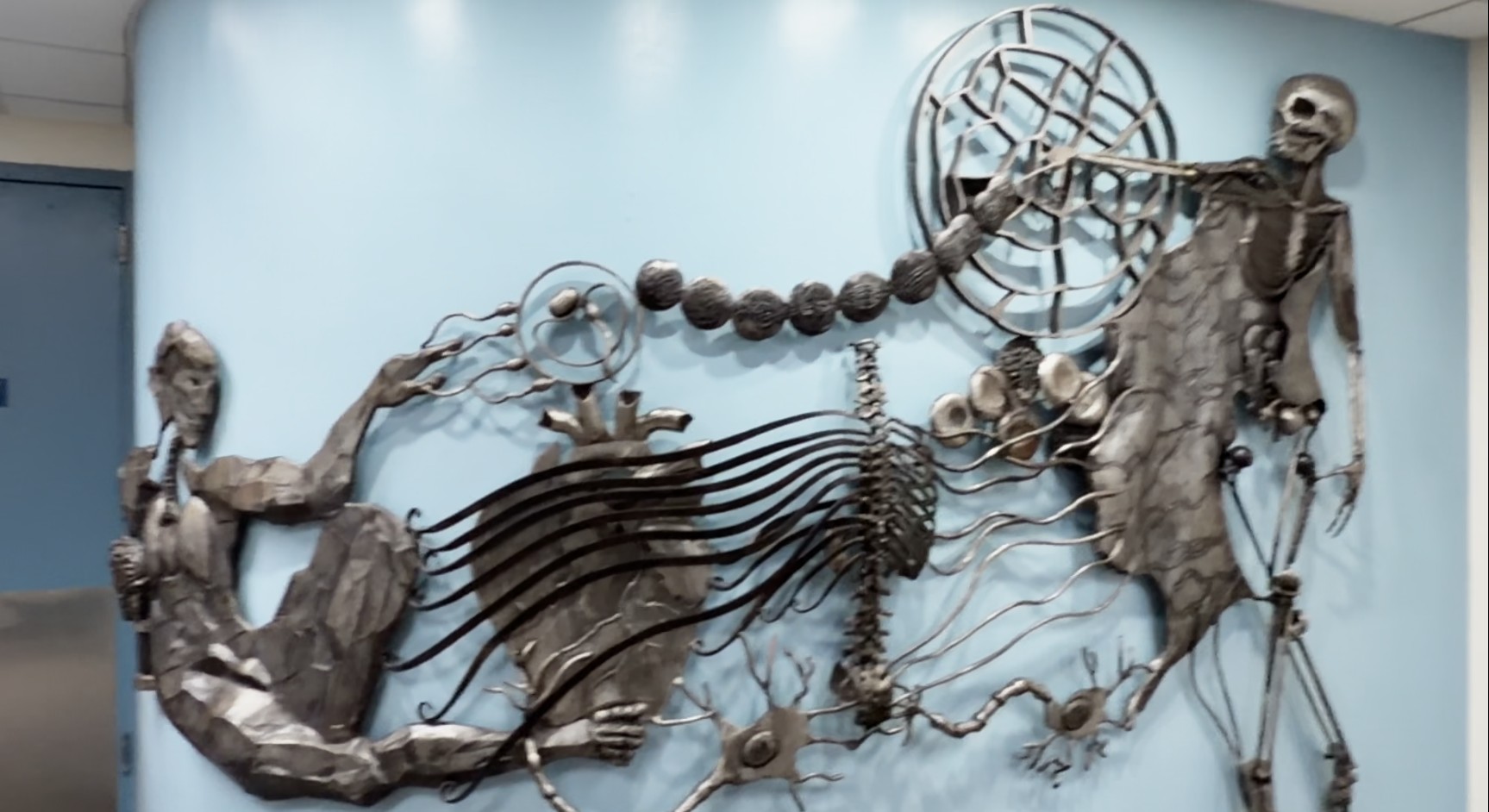
It is worth noting that the background Rose described in our interview—the repeated impact of rolling stretchers against the wall—is not merely a personal recollection that cannot be independently verified. As early as April 24, 2015, The New Yorker, in a profile of New York metal artist Kristina Kozak, documented the situation in very specific terms. The article noted that gross anatomy students at SUNY Downstate repeatedly pushed their stretchers into the wall, and that Kozak addressed the problem with what the article described as a "skeleton-shaped bumper." The piece later appeared in the magazine's May 4, 2015 issue. (The New Yorker)
Two months later, on June 25, 2015, Village Voice further revealed the artistic identity of the work in a feature on Kristina Kozak. The report specifically mentioned one of Kozak's large-scale works that was not easily accessible to the public—a metal reinterpretation of Michelangelo's The Creation of Adam, installed in an underground space at SUNY Downstate Medical Center.
Together, these two New York media reports from 2015 preserve two key parts of the project's history: The New Yorker documented the practical problem the project was intended to solve—stretchers repeatedly striking the wall—while Village Voice documented the artistic form into which that functional solution was ultimately transformed—a metal version of The Creation of Adam.
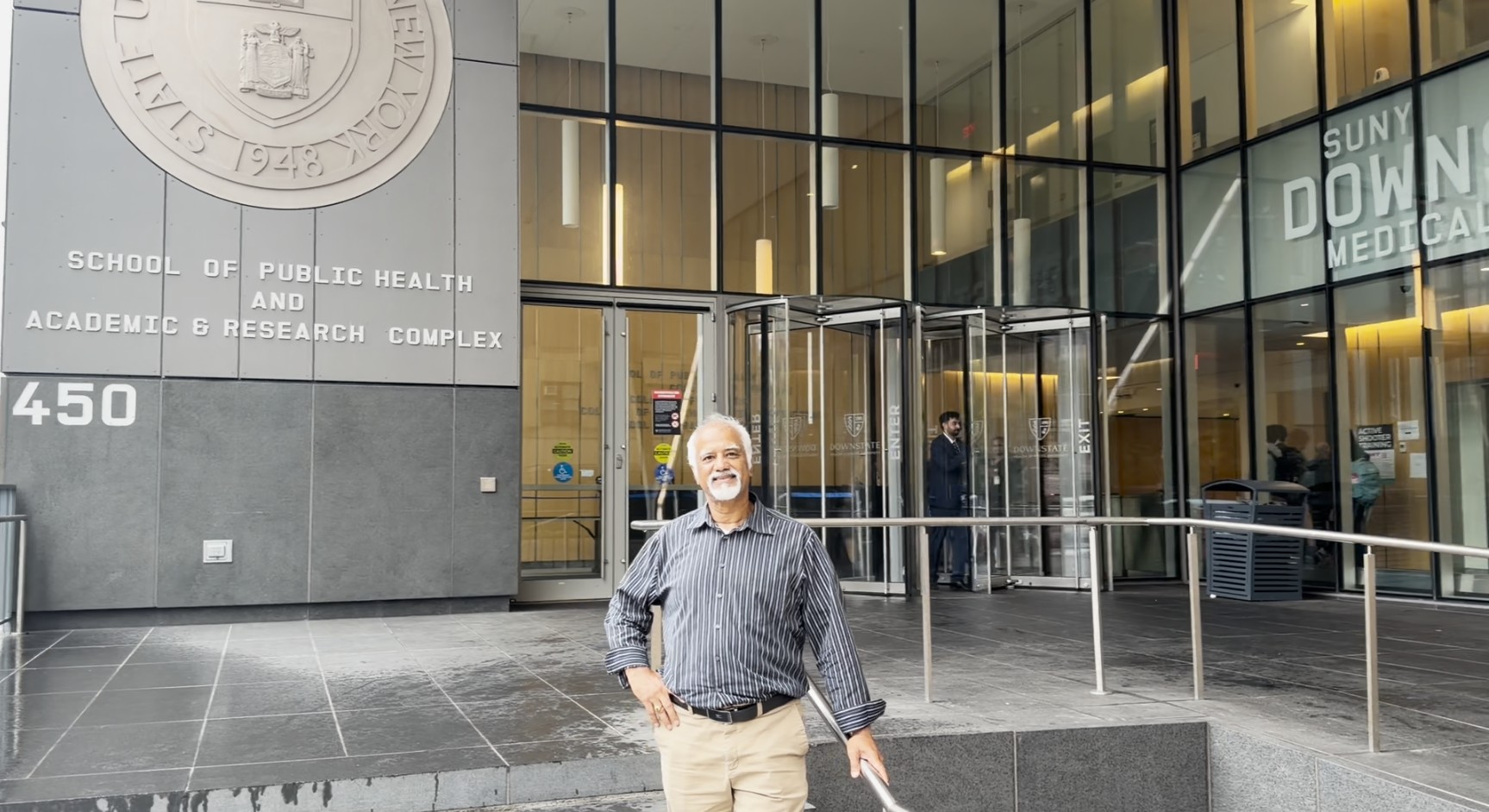
However, in the two publicly available reports reviewed by Celebrity Media, neither mentions Lee D Rose's role in developing the project's original design concept.
That is precisely the important missing part of the story revealed through this interview. Our reporter happened to meet Mr. Lee D Rose, which led to this conversation and the opportunity to document the design process directly from him.
According to Lee D Rose, he conceived the original design for the project, combining the practical need for wall protection with the visual language of human anatomy. Metal artist and sculptor Kristina Kozak then used her expertise in steel, form, metalworking, fabrication, and sculpture to transform that design concept into the physical artwork.
The roles of Rose and Kozak were therefore distinct but complementary: Rose developed the original design concept and connected the functional problem to the anatomy teaching environment, while Kozak realized that concept in steel through her artistic and sculptural craftsmanship.
This division of roles also helps explain why the final result went far beyond an ordinary facilities product and became a highly accomplished work of art.
From a purely engineering perspective, a row of metal guardrails, an impact-resistant wall panel, or even several rubber bumper strips would have been sufficient to protect the wall. But Rose was dealing with more than a wall vulnerable to damage. He was working within a very particular environment—a human anatomy teaching space.
As a result, the human body itself became the language of the design.
Kozak's contribution likewise went far beyond the fabrication of a conventional guardrail. She transformed cold, rigid metal into skeletal forms, anatomical structures, and continuously flowing sculptural lines, giving artistic form to a structure whose original purpose was to absorb impact and protect the wall.
Even more ingeniously, The Creation of Adam—one of art history's most iconic images of life being given—was reintroduced into the context of medical education.
In Michelangelo's original work, God and Adam extend their fingers toward one another, leaving a narrow space between the two figures in which they almost touch but do not. That image has become one of the most recognizable visual symbols in the history of world art. At SUNY Downstate, the composition was reinterpreted through metal and anatomical imagery, creating a distinctive connection with the bones and structures of the human body that medical students study every day.
Art history, medical education, and architectural space are thus connected within a single work.
Kristina Kozak's own creative philosophy closely aligns with the qualities embodied in this project. She has described herself as a craftsperson as well as an artist, sculptor, and designer. In particular, she has used the term "functional art" to describe the direction of her work. A work of this level could only be realized by a highly skilled metal artist and sculptor with a deep command of craftsmanship, form, and material.
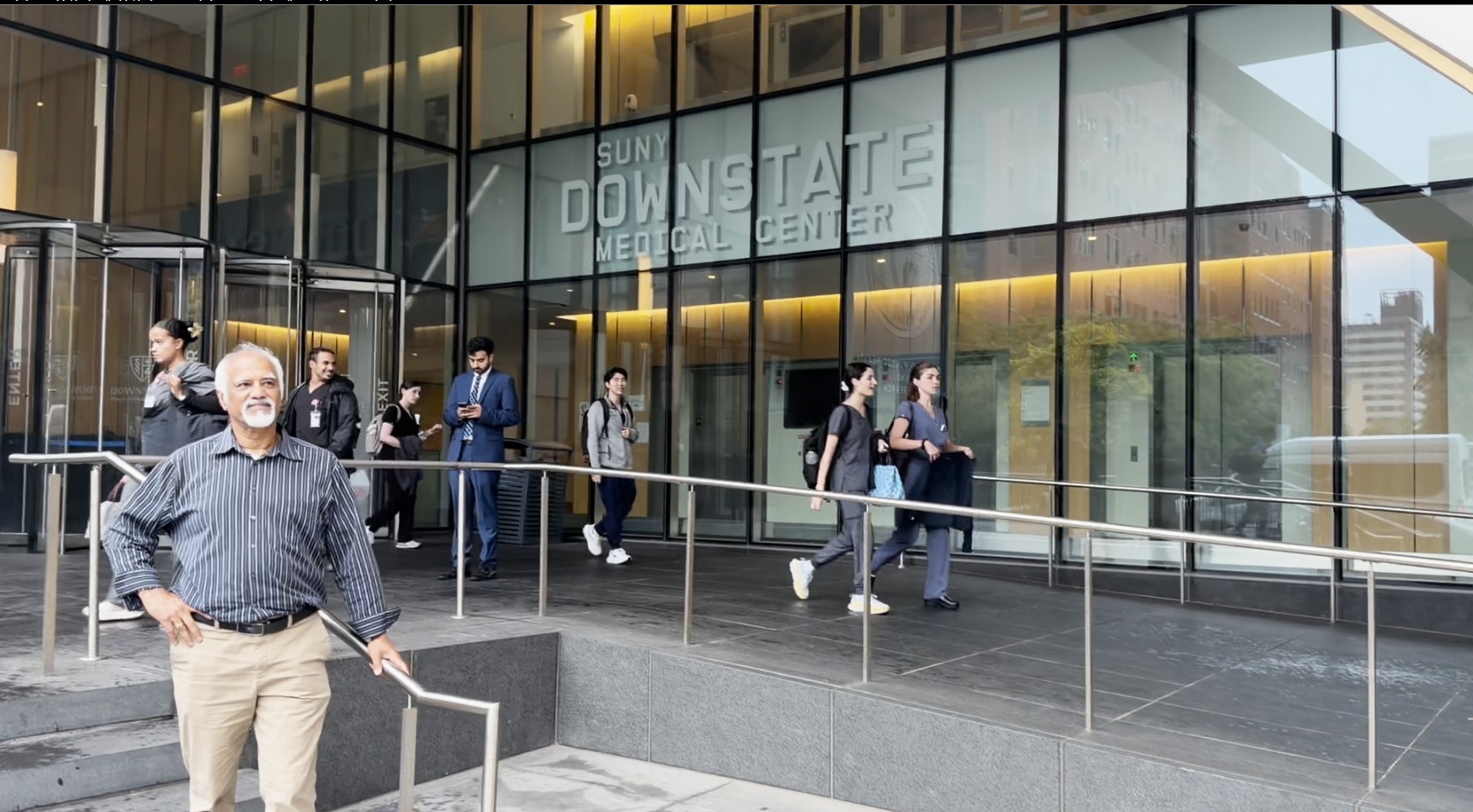
In April 2024, when SUNY Downstate introduced its Real Estate Operations department, the university explicitly identified Lee D. Rose as an architect and as the department's Assistant Vice President. According to university information, this is his second period of service at Downstate. Between his two tenures, he was also responsible for the development and construction of multiple healthcare spaces in New York City and Long Island. Today, the department he leads is involved in architecture, construction, real estate, and healthcare-space development.
Viewed in light of these public records, the design thinking Rose brought to this earlier project becomes even clearer: design is not simply about making a space "look better." More importantly, it is about identifying real-world problems and finding solutions that balance function, safety, environment, materials, and the people who use the space.
In this case, the problem was extremely concrete. Stretchers were hitting the wall. The wall needed protection. And the setting was a human anatomy teaching environment. If only the first problem had been addressed, the result might have remained merely a piece of building infrastructure. If visual expression alone had been pursued, it might instead have become decoration disconnected from the actual needs of the space.
Rose's concept brought these two dimensions together, while Kozak's expertise in metal art and sculpture gave the concept a tangible form capable of existing within the architectural environment itself. In the end, what might otherwise have been merely an "impact-protection device" was transformed into a highly accomplished work of public art with a clear medical theme.
Celebrity Media's direct video interview with Lee D Rose adds an important element to the history already documented in the public record—the original design inspiration behind the work and Lee D Rose's role in conceiving and developing that design.
The reports from 2015 tell us that students' stretchers repeatedly struck the wall. They also tell us that Kristina Kozak created a metal version of The Creation of Adam at SUNY Downstate. What Lee D Rose now explains directly is the crucial step that connects those two facts: how an ordinary facilities-maintenance problem was redefined, through design, as an opportunity for artistic creation.
Lee D Rose conceived the design solution. Kristina Kozak transformed that solution into steel and sculpture. Their collaboration turned a practical architectural problem into a work in which function, medicine, design, and art became inseparable.
Embedded in this story is also a broader lesson about the nature of design: sometimes truly outstanding design does not begin with the thought, "I want to create a work of art." It begins with an ordinary problem—there is a wall here that keeps getting hit. Can we find a better solution?
Lee D Rose's answer was design. Kristina Kozak's answer was steel, craftsmanship, and art. Together, those answers became a work of functional art.